Objectives, content and assessment criteria of a subject. Not just the format of the activities.
Curriculum modifications · Guide and examples
Curriculum modification: what it is, how it's done, examples, without starting over
A curriculum modification changes what a student has to learn in a subject: its objectives, content and assessment criteria. It is scaled down for students with special educational needs and extended for gifted students. Done well, their test is still their class's test.
Guide updated in October 2026 · Nubo pedagogy team
1 · What it is
What a curriculum modification is.
It is the measure that changes what is learned, not just how it is accessed. And it isn't always about scaling down: it can also extend.
Scaled down for students with special educational needs and extended for gifted students.
It is decided as a team after the psychoeducational evaluation and approved in their plan before any material is adapted.
| Non-significant | Significant | Extension | |
|---|---|---|---|
| Who it is for | Any student who needs it, depending on the region | Students with special educational needs (SEN) | Gifted students |
| What changes | Activities, methodology or assessment tools | Competencies, content and assessment criteria, scaled down | Competencies, content and criteria, extended or deeper |
| Reference level | Their own grade | Another grade, usually a lower one | Their own grade in greater depth, or a higher one |
| Who decides | The teaching team, with the homeroom teacher | The team, after the psychoeducational evaluation and informing the family | The team, after the psychoeducational evaluation and informing the family |
| How they are assessed | With the criteria of their grade | With the criteria of their modification | With the criteria of their modification |
| Graduation | Not affected | In ESO, it doesn't block graduating on its own; in Bachillerato they don't exist | Doesn't block it |
General framework of Spain's LOMLOE law. Each region gives it its own name and procedure (ACI, ACS, ACAI, PTI, PAP, PI…), and in some the non-significant one no longer exists as such. What it is called in yours.
2 · The problem
Why it's so hard to do well.
A generic AI doesn't work here: it doesn't know the objectives in the student's plan or what the regulation requires. So the modified version is made by hand, hunting for activities from other grades, other books and other worksheets. The result is a collage: every piece with its own format and topic, hours of work, and a student who ends up taking a different test from the rest of the class.
- Hours for every test
- Activities with no common thread
- A separate test, apart from what their class is doing
Math test · Mark's version⏱ 0 h 00 min
Grade 4 worksheet
Calculate: 345 + 278 = ___
Grade 5 textbook · p. 87
A pizza has 8 slices. If you eat 3, what fraction is left?
Summer workbook
7 TIMES TABLE: 7 x 6 = ___ 7 x 8 = ___
Downloaded from the internet
A train travels 120 km in 2 hours. How many km does it travel in one hour?
Photocopy from another school
Color half of the apples.
5 sources5 formatsNot one elephant
3 · What it should look like
A good curriculum modification meets five criteria.
They come from our white paper “Adapt without watering down”. They apply whether you do it by hand or with Nubo.
Starts from their plan
The objectives and criteria are already set in their approved plan. Each activity is adapted to them, not to the intuition of the moment.
The same context as their class
Same topic, same images, same moment. If the class works with elephants, so does their version: that way they don't work apart.
Only what needs it
If an activity is already within their reach, it stays as it is. Not the whole test changes.
In whichever direction is needed
Scale down what their plan scales down, extend what their plan extends. Never out of habit, never by default.
Open to review
Their reference level is reviewed at least every assessment period. A modification is not forever.
Same context for the whole class
Original · 7th grade
An elephant eats three times as much fruit in the morning as in the afternoon: 20 lb in the whole day. How many pounds does it eat in the afternoon?
x + 3x = 20Modified · Nora · 4th-grade level
An elephant eats 5 lb of fruit in the afternoon and three times as much in the morning. How many pounds does it eat in the whole day?
5 × 3 + 5 = ?Modified · Anna · 2nd-grade level
An elephant eats 15 lb of fruit in the morning and 5 lb in the afternoon. How many pounds does it eat in the whole day?
15 + 5 = ?What it looks like
A different level, the same context.
In a significant curriculum modification, the difficulty changes, not the story. If the class solves problems about elephants, so do Nora and Anna. When they finish, the whole class has worked on the same thing, each at their own level.
- Nobody works from a separate worksheet
- The same topic, at their reference level
- It can be graded and discussed together
And upward
For gifted students: the same topic, in more depth.
An extension doesn't mean handing out more exercises. It changes what is asked: connect, predict, justify. Grace works on the same ecosystem as her class, with a higher ceiling.
- More depth, not more volume
- The same topic as their class
- With the extended criteria of their plan
The class · Life science, Grade 7
Explain what would happen if the herbivore population in an ecosystem decreased.
 Extension · Grace
Predict how plant, herbivore and carnivore populations would change over five years. Draw the graph and justify each change.
Same topic, higher ceiling4 · How Nubo does it
Impossible by hand. This is how Nubo does it.
With their approved plan and your test, Nubo prepares their version, meeting all five criteria.
Mark's planMath · 5th-grade reference levelLanguage arts · their own grade✓ Approved by the counseling team
The objectives and criteria for each subject, decided as a team.
Math test · Grade 8
You upload the same test the rest of the class will take.
Math test · Mark's version✓ Activity 1 · to their reference level✓ Activity 2 · to their reference level= Activity 3 · already within reach
Nubo converts each activity to the objective in their plan, on the same topic. You review and confirm.
By hand: a collage of worksheets from other grades, hours per test and a test different from their class's.
With Nubo: your test, at their level, in minutes. It follows their plan and their class works on the same thing.
Bring it to your classroom
Two ways to adapt well with Nubo.
Same approach, two starting points: your own material, or the whole school at once.
For teachers
Adapt your next test.
Upload your material and get a version for each student in your class, based on their profile. You review, adjust and download.
- Free to start
- PDF, Word or PowerPoint
- An average test, in 3 or 4 minutes
One consistent approach across the whole school.
The counseling team agrees on the supports once, and each teacher applies them when adapting their material. Every change is logged.
- Accommodations, modifications and Smart UDL
- The whole team in sync
- We'll show you with your own material
Go deeper
More on adaptations and assessment.

Real cases
Teachers already using it in their classrooms.
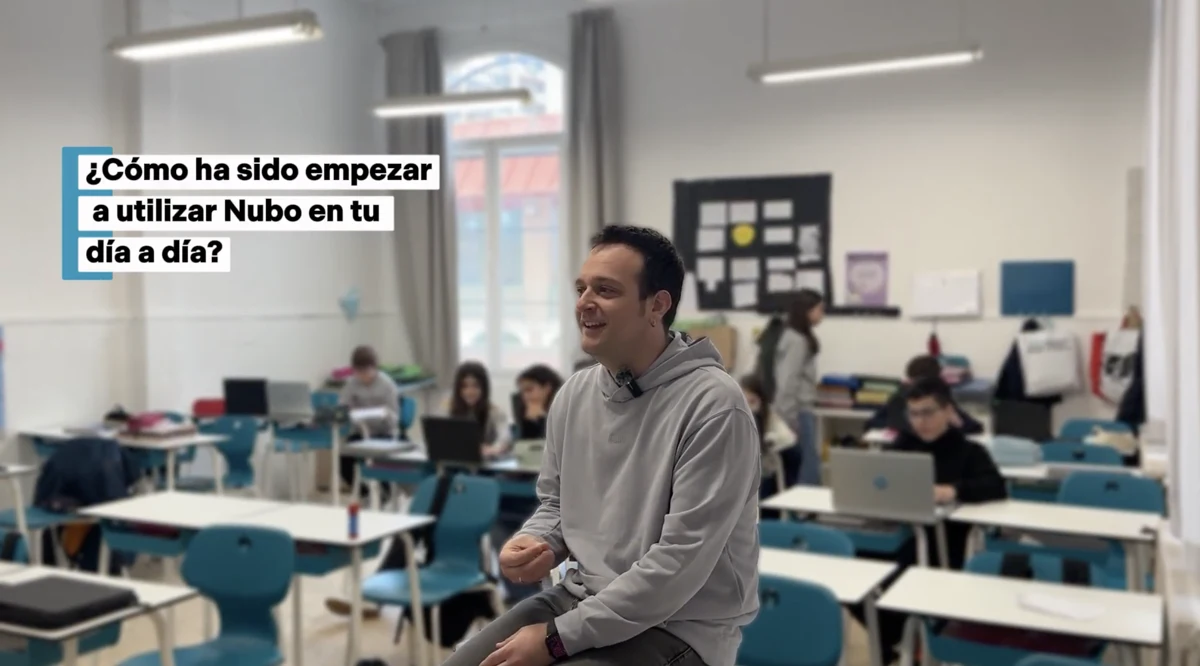 Watch the interview ↗
“You realize that the material you thought was good could be much better, and that it can be adapted much more closely to specific profiles.”
Joan · Assistant principal, counselor and language teacher · Maristes Montserrat, Lleida (Spain)
Read the full case →“My student no longer worries about whether he can do the task. He knows he can do what is put in front of him each day.”
Homeroom teacher · CEIP Justicia de Aragón (public elementary school), Alcorisa, Spain
Read their story →“What stayed with me most was the enthusiasm of the teachers when they came out of the training and said it was very practical and very concise.”
Ana · Director of the Alcorisa Teacher Training Center (Spain)
Read their story →Frequently asked questions
Frequently asked questions about curriculum modifications
What is a curriculum modification?
It is a measure that adjusts the elements of the curriculum (content, objectives or assessment criteria) to a student's needs. Unlike an accommodation (a methodological adaptation), it changes not only the how but also the what.
What is the difference between a significant and a non-significant curriculum modification?
A non-significant one adjusts content and activities without altering the minimum objectives and criteria of the stage; it is closer to what US schools call an accommodation. A significant one changes objectives, content and assessment criteria, using another grade as the reference level. The name and the procedure depend on each autonomous region of Spain.
What are examples of significant curriculum modifications?
Working on 8th-grade fractions at a 5th-grade reference level, or doing a 9th-grade text analysis by identifying only the main idea of a passage. Ideally the context stays the same as the class: same topic, different level.
How is a curriculum modification made?
With a psychoeducational evaluation by the counseling team, a reference level set for each subject, the modification written into the support plan, each material adapted to that reference level, and periodic review. Nubo supports each step.
Who can have a significant curriculum modification?
Under Spain's national rules, students with special educational needs (SEN), for example because of a disability. A specific learning difficulty such as dyslexia is normally addressed with accommodations and, if needed, non-significant modifications. Each region specifies the procedure.
Who decides on a significant curriculum modification?
The team, never a single person or a tool. It requires the counseling team's psychoeducational evaluation, informing the family, and recording it in the support plan and the assessment documents. It is approved by the school principal or the education inspectorate, depending on the region.
How is a student with a significant curriculum modification assessed?
With the assessment criteria set in their own modification. That is why it matters that they are written down in their support plan.
Does it affect graduation?
In ESO (compulsory secondary school, roughly grades 7 to 10), the national rule states that being assessed with the modification's criteria cannot by itself block promotion or graduation; the teaching team decides on the diploma based on the competencies of the stage. In Bachillerato (the two-year pre-university track) there are no significant curriculum modifications: there are access accommodations, split exams and exemptions.
Can an AI make a curriculum modification?
A generic AI doesn't know the objectives or criteria in the student's plan, so it can't do it well. Nubo starts from their approved plan: it converts each activity in your test to their reference level, on the same topic, and shows you only the options the plan allows.
Do gifted students get a curriculum modification?
They can get an extension or enrichment modification: the work goes deeper or brings in content from higher grades, according to their plan and each region's rules. It is different from acceleration, which moves a student up a grade.
What is it called in my region?
Each region uses its own name and format: ACI, ACS, PTI, PAP, PI… See each region's support plans.
Adjust the content. Never the goal.
With your material or with your whole school, every change comes with its reason.