Cognitive load theory
We break complex instructions into segments so effort goes into learning, not decoding.
Accommodations · Middle and high school
An accommodation changes how a student gets to the task and how they respond, without touching the objective or the assessment criteria. It is the first response, and almost always the fairest.
Guide updated in October 2026 · Nubo pedagogy team
Nubo doesn't give you a checklist of supports to tick: it looks at the student's profile and what the question asks, and applies only the ones that are needed.
Explain what would happen if the herbivore population decreased, and connect your answer to the balance of the ecosystem.
 For PaulHe has trouble holding several instructions in mind and loses the thread
Nubo is matching his profile against what the question asks…
Not applied: extra time or visual support. He doesn't need them for this task.
✓ Objective and assessment criteria: the same
Definition
An accommodation changes the way in, never the destination.
If anything in this column has to change, it is already a curriculum modification.
Examples
By profile, in class and on tests.
Examples for guidance only. The label points the way; what decides is what is hard for each student in each task.
By type of support
| Type of support | What changes | Examples |
|---|---|---|
| Access to information | How it is presented | Clear type, 1.5 line spacing, highlighted key words, visual supports |
| Instructions | How the task is explained | Step-by-step instructions, one at a time, with a worked example |
| Time | How much and how it is divided | Extra time, breaks, the test in two sessions |
| Response | How they show what they have learned | Orally, with a diagram, by choosing, matching or completing |
| Environment | Where and with what they work | Seating in the classroom, fewer distractions, support materials |
| Assessment | With which tools | A variety of tools and criteria known in advance |
Names vary by region in Spain: ordinary measures, general measures or methodological adaptations.
Before and after
The same question, with the same level of demand: two economic changes, two social changes and how they relate to the steam engine. Only the path to get there changes.
Not every support helps
Some very common accommodations don't help, or help less than they seem to.



 +10

 +6

✓ 3 versions of the same test · 4 min
With Nubo
With Smart UDL, Nubo groups your class by similar profiles and prepares a version of the same test for each group, with the supports that group needs. Everyone works on the same thing.
Evidence
Our method draws on research on cognitive load, multimedia learning and Universal Design for Learning.
We break complex instructions into segments so effort goes into learning, not decoding.
We reorganize the visual format and signal what matters.
Multiple ways to access and to respond: the basis of Smart UDL.
See science and evidence · White paper “Adapt without watering down”
Bring it to your classroom
Same approach, two starting points: your own material, or the whole school at once.
Upload your material and get a version for each student in your class, based on their profile. You review, adjust and download.
The counseling team agrees on the supports once, and each teacher applies them when adapting their material. Every change is logged.
Real cases
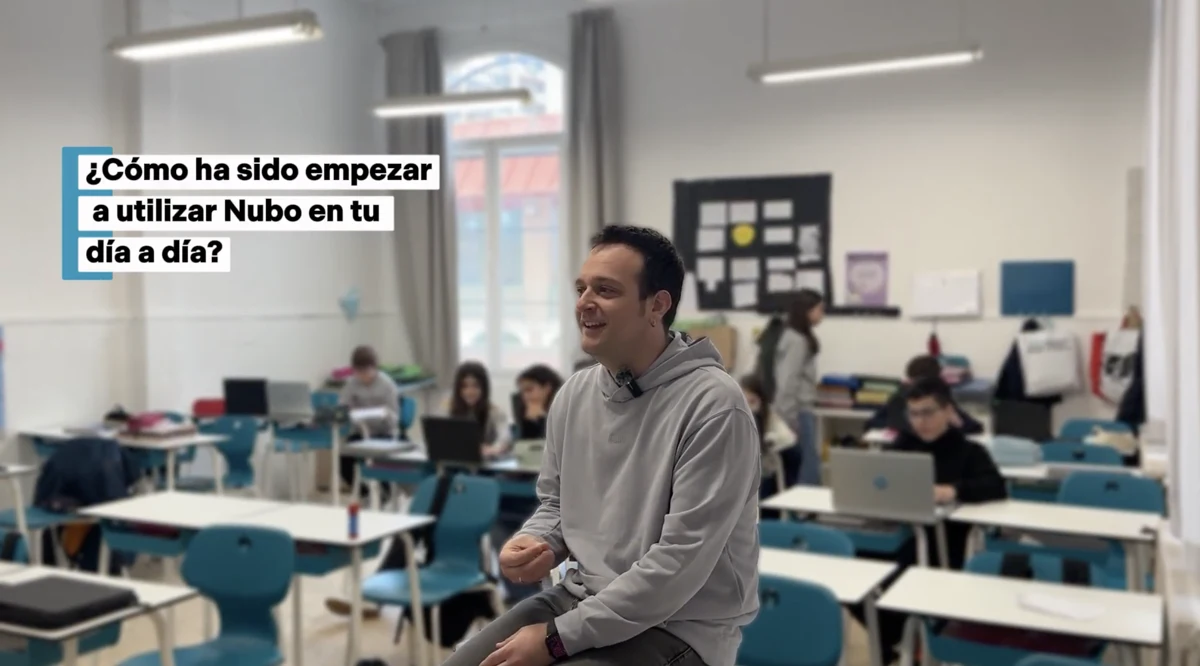 Watch the interview ↗
“You realize that the material you thought was good could be much better, and that it can be adapted much more closely to specific profiles.”
Joan · Assistant principal, counselor and language teacher · Maristes Montserrat, Lleida (Spain)
Read the full case →“My student no longer worries about whether he can do the task. He knows he can do what is put in front of him each day.”
Homeroom teacher · CEIP Justicia de Aragón (public elementary school), Alcorisa, Spain
Read their story →“What stayed with me most was the enthusiasm of the teachers when they came out of the training and said it was very practical and very concise.”
Ana · Director of the Alcorisa Teacher Training Center (Spain)
Read their story →Frequently asked questions
It is an ordinary measure that changes how a student receives information and how they show what they have learned (format, instructions, time, visual supports or the way of responding). Objectives, content and assessment criteria are not touched. Access adaptations, strictly speaking, are something else: resources and communication systems such as braille, sign language or communication devices.
Giving instructions in steps, highlighting key words, allowing extra time or splitting a test into two parts, allowing oral answers or a diagram, or previewing the session with a visual schedule. Above you will find examples by profile: dyslexia, ADHD, autism, gifted students and newly arrived students.
In many regions of Spain, yes: a non-significant adaptation changes the methodology, activities, timing or assessment tools without touching the assessment criteria, just like an accommodation. Some regions also use it to prioritize or sequence content, and others no longer use the term. What never changes in either case is the assessment criteria for the student's grade.
An accommodation changes the how; a modification changes the what too. A significant curriculum modification changes objectives, content and criteria, and can affect graduation. An accommodation lets a student keep pace with the class without lowering the standard.
Generally not: they are ordinary measures decided by the teaching team. It helps to record them in the student's support plan so the whole team applies them the same way. For Bachillerato and the PAU (Spain's university entrance exam), adapting the tests usually requires the student to be identified as having learning differences (NEAE) and a report. The exact procedure depends on your region.
Yes, as long as they don't change what is being assessed. Reading the question aloud makes sense on a science test, but not on a reading comprehension test.
No. They work for any student who runs into an access barrier, with or without a diagnosis. What decides the support is what is hard for the student in each task, not the label.
Because studies don't show that changing the font alone improves reading speed or accuracy. There is somewhat more evidence, though modest, for larger type and more space between letters. If a student finds it more comfortable, they can use it.
Yes. You can create your free account and adapt your materials on your own. If your school joins, the profiles are linked and nothing is duplicated.
Try it with your next test, or take it to your whole school.
Free for teachers · Demo for schools